Chakana The Inca symbol of healing
“Within this symbol lies all our ancestral wisdom and power.”
What is the Chakana in Inca spirituality
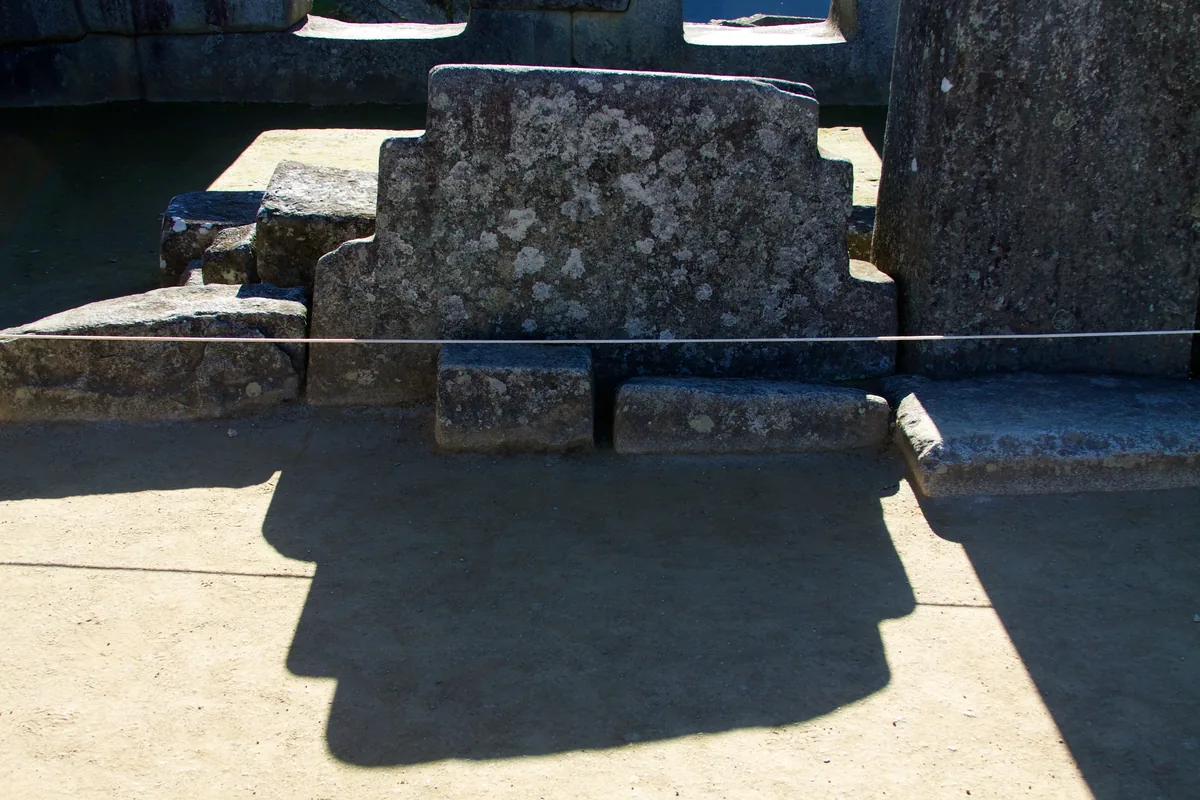
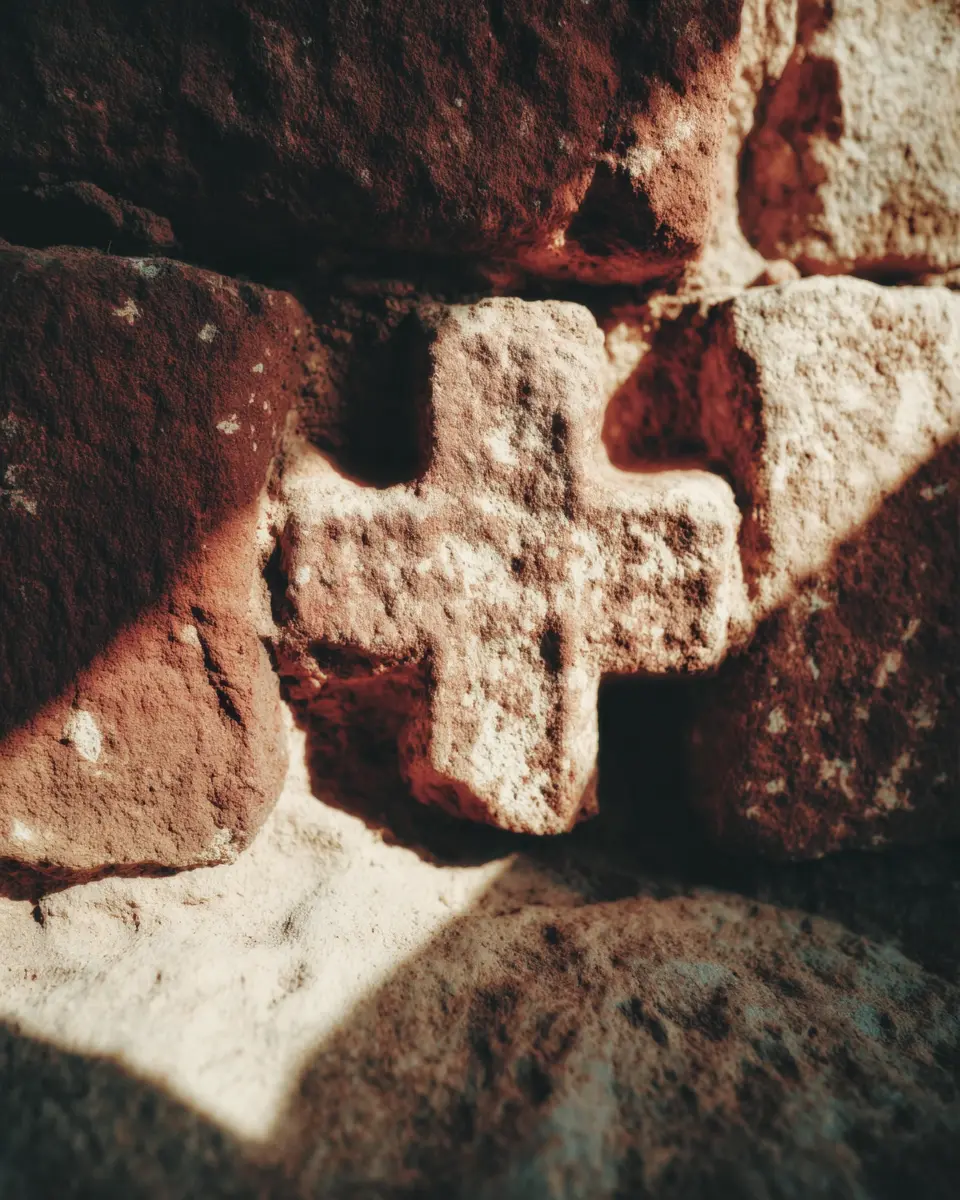
The Chakana is the Andean cross — one of the most ancient and complete symbols in Inca cosmology. Its stepped form encodes three worlds (Ukhu Pacha, Kay Pacha, Hanaq Pacha), four directions, and the relationship between earth and cosmos. As the third of the 5 Inca Codes, the Chakana teaches that healing and true growth come from living in alignment with a larger order — not just our immediate impulses, fears, and desires.
From the moment I arrived at the maestro’s house, all I felt was peace. The kind that the body recognizes before the mind understands it. There were large gardens around the main house and small earthen paths marked by rosemary plants, lavender, and other Andean medicinal herbs. Everything seemed alive. Everything seemed cared for.
About two hundred meters away I saw a fire and several people gathered around it.
I approached in silence.
They were men and women, mostly between forty and eighty years old, dressed in ponchos, vinchas, and beautiful Andean ceremonial garments. Each carried bundles made from colorful hand-woven blankets. With great attention, they placed them on the earth before the fire, until they formed a kind of cross almost four meters wide by four meters long.
But it was not a cross like the Christian one. It was perfectly square. Balanced. Stepped. Beautiful and imposing at the same time.
One of the oldest men noticed my expression of wonder, smiled gently, and whispered in my ear:
— It is the Chakana, brother.
In that moment I did not yet understand everything. But something within me knew I was standing before a way of seeing the universe.
In the Andean tradition, the Chakana is the symbol that synthesizes and brings together all our wisdom. A way of remembering that life is not separated into loose parts, but organized into levels that correspond with one another: the inner world, concrete life, and the spiritual plane. A way of reconciling opposites and bringing peace and harmony.
It is a very ancient symbol. In the studies preserved in this tradition, its presence goes back to times long before the Inca Empire, appearing in sacred places of Peru more than 6000 years old. This already shows us something important: the Chakana is not just a code.
But it is much more than that. It is important because it is a bearer of health and harmony.
The Chakana was drawn to communicate order, center, and proportion through its geometry. It teaches, without words, that the true spiritual path lies in the conscious harmonization of all the forces that sustain us.
A symbol linked to the sky
One of the most beautiful keys to understanding the Chakana is knowing that the ancients understood it as a representation of the Southern Cross.
This means it did not arise only from symbolic imagination, but from the observation of the sky.
The Andean peoples knew that human life must be in relationship with the cosmos. For them, observing the stars was not just studying astronomy. It was learning to live better. It was aligning what we do here below with a greater order.
Today many people live disconnected from this principle. They rush, produce, decide, consume, react. But they rarely ask themselves: Is my life in harmony with something greater than my impulses, my fears, and my immediate desires?
The Chakana emerges as an answer to this question.
It reminds us that living well goes beyond having goals and material success. It is finding balance:
with the earth,
with the cosmos,
with society,
and with ourselves.
This is what leads to true health and happiness. This is what can help you reach your goals with greater ease and bring their benefits to those around you.
The three worlds
The most well-known form of the Chakana expresses the three worlds of Andean cosmovision.
Ukhu Pacha
It is the inner and deep world. Something no one talks about is that it represents the space of shadows, wounds, unresolved emotions, what we carry without noticing. The response we give from our wounds. The id.
Kay Pacha
It is the present world. The here and now. Our body, our routine, our relationships, our choices, our concrete life. Responding from the here and now. The ego.
Hanaq Pacha
It is the elevated and subtle world. The plane of inspiration, higher consciousness, the world of subtle ideas, spirits of light, and all that is most noble within us. The superego.
The beauty of this vision lies in the fact that these three worlds are not separate.
What we ignore within ourselves affects our external life.
The way we live day to day influences our openness to the sacred.
And what we feel in the spiritual plane only becomes true when it gains form in our actions.
The Chakana teaches us exactly this:
it is not enough to seek light.
We must integrate.
If you want to know more about the medicine of the Chakana, how to use it to heal yourself, and the magical Andean practices associated with it, I invite you to study the course “The Inca Medicine of Relationships”.
Balance is not the absence of problems
When we speak of balance, many people imagine a life without conflict, without pain, without tension. Like that of a spiritual guru.
But balance in our view is not that.
Balance is not a life without challenges.
It is a life in constant adjustment. Something like balancing on a bicycle on a difficult trail. A constant effort to navigate obstacles with mastery so as not to fall.
Right relationship with the body.
With the mind.
With the earth.
With time.
With others.
With the invisible.
The unbalanced person is not just the one who suffers. It is also the one who lives fragmented. The one who wants spiritual development but despises concrete life. The one who speaks of energy but cannot coexist well. The one who seeks the heights but never descends to their own wounded heart.
The Chakana restores center.
It teaches us that growing spiritually does not mean leaving the world. It means learning to inhabit it with more consciousness.
Life as a sacred path
In the Andean tradition there is still a very profound relationship between the Chakana and the way the ancients organized their paths, their temples, their rites, and their orientation in the world.
There is vast, beautiful, and surprising knowledge here — involving sky, earth, sacred geography, and human development. This is a theme that does not fit entirely in this chapter. And perhaps it is right that it be so.
Because some things should not be delivered all at once.
Some need to be approached gradually, with respect, practice, and inner maturity.
For now, it is enough to understand the essential: for us, walking is not just about moving. It is about aligning ourselves. The great symbols, like the Chakana, serve to guide the journey of life.
What the Chakana can teach today
Perhaps you will not live in Peru, on a sacred mountain. Perhaps you will not participate in a ceremony before the fire. Perhaps you will never see a Chakana woven on the earth as I saw it that day.
But that does not mean this symbol has nothing to say to you.
On the contrary.
The Chakana is profoundly current, because the modern human being has lost center.
We are full of information, but without direction.
Full of stimulation, but without silence.
Full of connections, but with little true relationship.
Full of techniques, but poor in wisdom.
The Chakana reminds us that life needs an axis.
It calls us back to balance with:
the cosmic positions,
Pachamama and her beings,
society,
our brothers and sisters,
and ourselves in the middle of this living web.
It reminds us that we are not owners of existence.
We are a bridge.
Between sky and earth.
Between what we receive and what we offer.
Between the memory of the ancients and the responsibility of living consciously today.
Simply wearing it on your chest will be a great help in your life.
The cross I saw on the earth
Over the years, I returned many times to that image.
The colorful blankets on the ground.
The fire burning.
The elders moving with serene precision.
The form of the Chakana appearing little by little before my eyes.
Today I understand that what moved me was perceiving, even before I could explain it, that reality could be lived in another way.
Without haste.
Without fragmentation.
The Chakana taught me this before I was able to put it into words.
And perhaps it continues to say the same to all those who contemplate it with sincerity:
life has a center. And returning to it is possible.
If you want to be nourished by the great wisdom of the temples of the Chakana in Machu Picchu, learn more about this year’s spiritual journey to Peru.
Frequently asked questions
What does the Chakana symbol mean?
The Chakana, or Andean cross, is a stepped cross that represents the structure of the cosmos in Inca tradition. It encodes the three worlds (underworld, earthly world, and celestial world), the four cardinal directions, and the relationship between human beings and the universe. It is both a map and a teaching about how to live in balance.
What are the three worlds in Andean cosmology?
In Andean cosmology, reality is organized into three worlds: Ukhu Pacha (the inner world, the subterranean realm of origins), Kay Pacha (the present world, the everyday human experience), and Hanaq Pacha (the upper world, the cosmic and celestial realm). The Chakana connects all three, reminding us that true balance requires awareness of all dimensions of existence.
Is the Chakana the same as the Southern Cross?
The Chakana was likely inspired by the Southern Cross constellation (Crux), visible from the Andes. But it is much more than an astronomical reference — it is a complete cosmological map. The Andean peoples observed the sky not just to study stars, but to learn how to live in harmony with a larger order.
The tradition that formed me
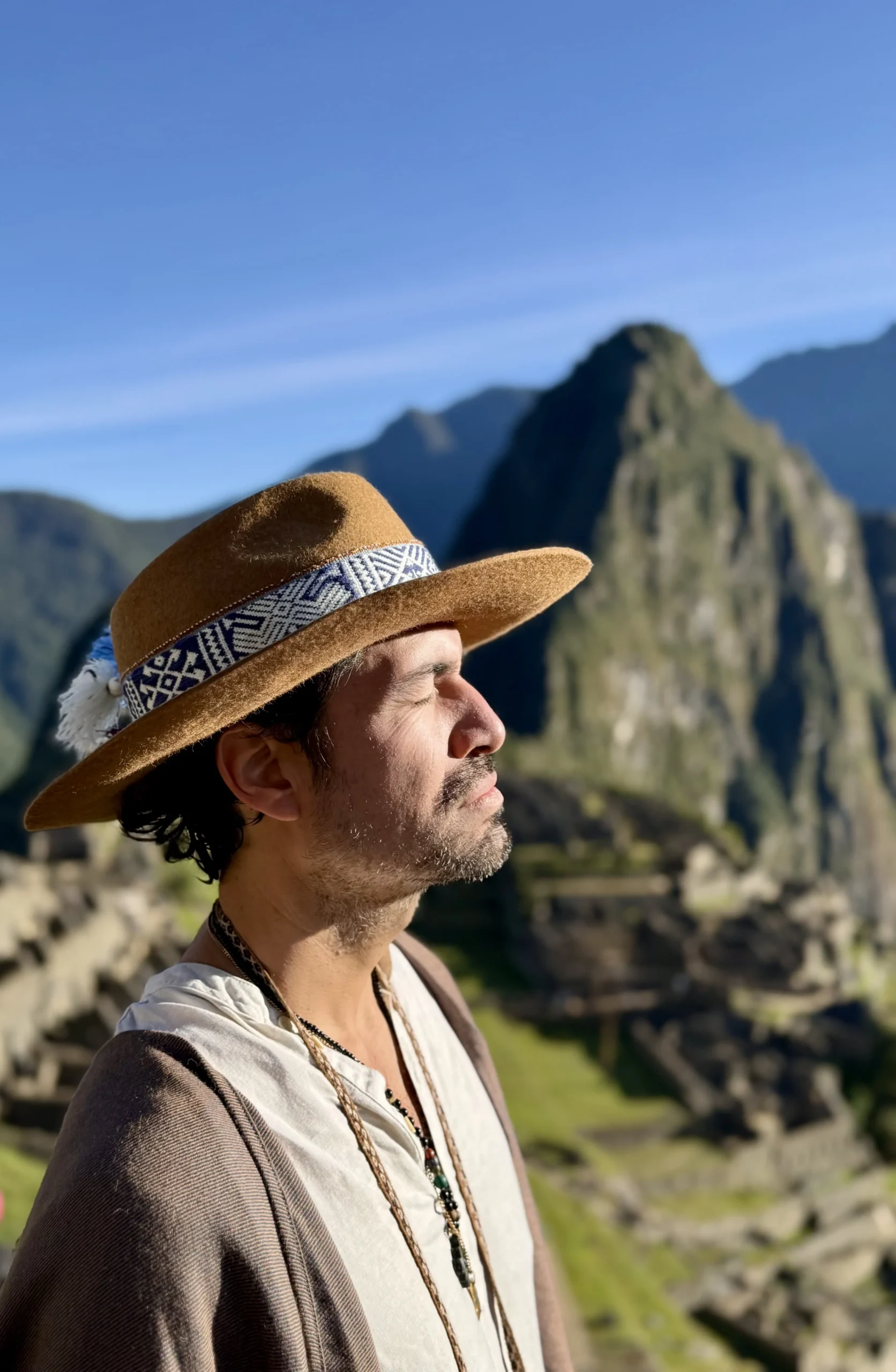
I was born in the sacred mountains of Peru. At age 8 I received my first initiation at Machu Picchu — and from that moment I have walked the Inca spiritual path.
For 11 years I have guided groups of spiritual seekers through the physical and energetic paths of Peru. These 5 codes that I share with you are the synthesis of nearly 40 years of spiritual experience, from that first initiation.
Walking with the 5 Codes in Peru
There is a difference between reading about the 5 Inca Codes and walking the stones that teach them. During the Spiritual Journey to Peru, the codes stop being concepts. They become ritual, story, experience — and stay forever in the heart.
Discover the Journey →